bus network

What is a bus network?
A bus network is a local area network (LAN) topology in which each node -- a workstation or other device -- is connected to a main cable or link called a bus. All connected stations on the bus can communicate with all others on the singular network segment.
A bus network topology is simple and reliable. If one station fails to operate, the rest of the stations can still communicate with each other. For a major disruption to take place, the bus itself must be cut or broken somewhere along the line. Bus networks are also easy to expand. Additional nodes can be added anywhere along the link.
The following bus network has five stations. Each station is shown as a sphere, the bus appears as a heavy horizontal line and connections to the bus appear as vertical lines.
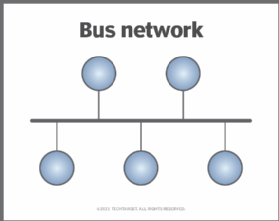
There are several limitations to the bus network topology, however. For example, the length of the bus is limited due to signal loss along the run. While repeaters can be used to boost signal with the purpose of extending the distance of a bus cable, other issues such as echoing can occur, making the extensions less functional the longer the bus length becomes.
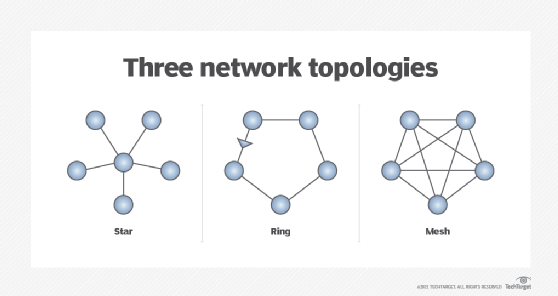
In addition, a bus network may not work well if connected stations are located at scattered points that do not lie near a common line. In situations like this, a ring network, mesh network or star network topology may be more flexible and cost-effective.
How do bus networks work?
Station devices connect to a bus network using physical network interface cards joined to a single cable -- the bus -- for transport to all other connected stations. When stations on the bus communicate, the data is broadcast to all devices on the bus. However, only the device the traffic is destined for will interact with the transmitted data. From an Ethernet perspective, for example, this is accomplished by defining the destination media access control address in the data frames that are sent across the bus.
Bus networks operate in half-duplex mode and with a single collision domain. This means that a station can send or receive data across the same network cable -- but only in a single direction at a time. Thus, if a station is currently transmitting data to another station on the bus, it cannot receive data at that exact moment. Instead, a transport mechanism must be in place, such as carrier-sense multiple access, where the station monitors traffic on the wire and only transmits data when no other devices are communicating on it. Alternatively, methods such as time-division multiplexing can be used so that each node on the device is granted a specific time slot when the network allows the sending of data.
What are the benefits of bus networks?
Easy to deploy. Bus networks are easy to deploy in basic settings where a handful of devices need to connect in a linear manner. This results in far less cabling needed to be run compared to other types of topologies, including ring and star designs.
Highly reliable. Bus networks are also considered dependable, compared to other topologies, like the ring topology, because a device that is added, removed or malfunctioning typically does not interfere with data transport of other stations or nodes on the bus.
Easy to extend. Bus networks can be extended through the use of a signal repeater. However, as mentioned previously, repeaters can sometimes introduce new problems into the bus, including echoes. Thus, repeaters should be used sparingly and installed by trained technicians.
What are the drawbacks of bus networks?
Lack efficiency. Half-duplex systems, such as bus topologies, are less efficient from a data transport perspective compared to full-duplex alternatives that enable devices to both transmit and receive data simultaneously.
Reduced quality of service. Because devices on a bus receive all data along the wire, network congestion can occur, severely limiting the amount of data that can be transported. The more devices that are added to the bus, the less efficient the bus network becomes.
Scalability challenges. Ultimately, bus networks are not scalable, and this and the half-duplex limitation and troubleshooting challenges are primary reasons why bus network topologies are rarely, if ever, used within modern enterprise network designs.
What is an example of a bus network technology?
The 10Base2 standard, also referred to as thinnet, is an example of how a single coaxial cable terminated with Bayonet Neill-Concelman connectors could be used to transmit and receive Ethernet frames on a bus network.
Once all devices along the bus have been connected, the bus is terminated on both ends. But the terminations could be removed if other devices or repeaters need to be added or if the network run needs to be extended. While 10Base2 networks have become extinct in favor of far more efficient Ethernet switching topologies, many older buildings still contain remnants of thinnet cabling in walls, ceilings and network closets.
As more workers return to the office under new hybrid work schedules, some organizations may have to update their network infrastructures to address concerns such as security, flexibility and access.