Open Shortest Path First (OSPF)
What is Open Shortest Path First (OSPF)?
Open Shortest Path First (OSPF) is an IP routing protocol that uses a mathematical algorithm to calculate the most efficient path to direct traffic on IP networks. OSPF is an open standard and designated by the Internet Engineering Task Force (IETF) as one of several Interior Gateway Protocols (IGPs) within the family of TCP/IP protocols.
Based on link-state or shortest path first (SPF) technology, OSPF distributes routing information between routers in a single autonomous system (AS). This capability differentiates OSPF from older TCP/IP routing protocols, which were designed for less complex networks than those used today.
Using Dijkstra's shortest path algorithm, OSPF calculates the shortest path for all routers in an area of the AS to efficiently use network bandwidth and ensure scalability. The AS may be divided into multiple interconnected networks, such as a wide area network (WAN). The topology is visible only to the routers in the same area.
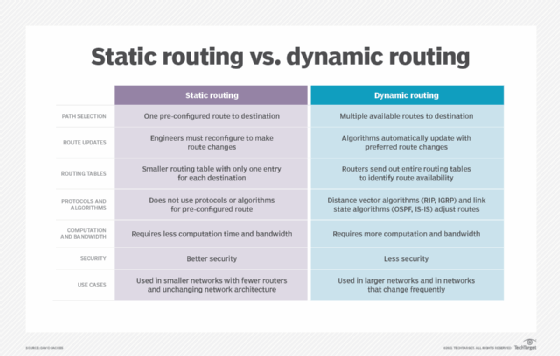
As a dynamic routing protocol, OSPF not only routes IP packets based on the destination IP address (given in the packet header), but it also detects topological changes in the AS. After detecting changes, OSPF calculates new, loop-free routes after a short period (known as convergence time) in which routing traffic is kept to a minimum.
All the routers in the same area of the OSPF network maintain the same link-state database that describes the area topology. Each router receives link-state advertisement (LSA) messages containing information about neighboring routers and path costs from the other routers in that area. Using these LSAs, each router generates the link-state database and uses the SPF algorithm to calculate a shortest-path spanning tree.
OSPF was designed and developed by the IETF for TCP/IP environments, mainly large enterprise networks. OSPF version 2 is defined in RFC 2328 of the IETF Network Working Group. This protocol is broadly implemented in enterprise routers. IPv6 revisions to this standard are captured in OSPF version 3 and defined in IETF RFC 5340.
How Open Shortest Path First works
Two important concepts in OSPF are areas and neighbors.
- Areas are groups of routers in an AS, essentially forming a collection of zones with logical boundaries. Areas are typically identified with a number. Area 0 is always the backbone, to which all other areas connect.
- OSPF-enabled routers in the same area establish "neighbor" relationships using a HELLO packet to exchange routing information.
In OSPF, the routers do not need to send the entire routing table to neighboring routers every few seconds. Instead, information is sent only when a change has taken place.
When an OSPF router in a given area of the AS that learns of a routing table change or detects a change in the network immediately multicasts the information to all other OSPF-enabled nodes in the area. Multicasting is a way to ensure every router in that area has the same information about the AS topology, a concept known as flooding. This information is used to calculate the best end-to-end path to the eventual destination in the AS.
Notably, the multicast contains only the latest update. Routing tables can be incredibly large, and retransmitting them in full every time can degrade network performance. When routes change -- which can occur due to equipment failure or the addition of new devices -- the time it takes OSPF routers to reconcile these changes and identify the best new, loop-free path between endpoints is called convergence time.
Open Shortest Path First (OSPF) and Interior Gateway Protocols (IGPs)
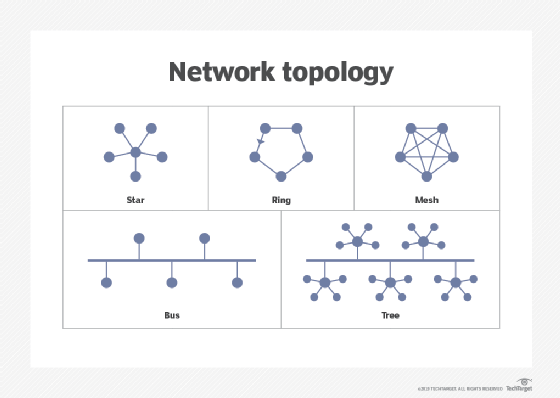
An Interior Gateway Protocol is aimed at traffic moving around within a larger AS network, such as a single enterprise network. It is used between routers running on TCP/IP hosts on that system. The system may comprise many separate local area networks (LANs) linked through routers, forming a WAN. Multiple IGPs are in use today, and OSPF is one of them. Some of the other IGPs include Routing Information Protocol (RIP), IPv6 RIP and RIP Version 2.
OSPF is a link-state routing protocol that sends information about directly connected links to all the routers in the AS network. The protocol has a full picture of the network topology, which is shared with all the routers in an area of the AS to calculate the shortest path to each destination.
One difference between OSPF and RIP is that, unlike RIP, OSPF does not simply count the number of router hops between hosts on a network. Instead, OSPF bases its path choices on "link states" that consider additional network information. The information might include IT-assigned cost metrics that give some paths higher assigned costs. For example, a satellite link might be assigned higher cost than a wireless WAN link, which in turn might be assigned a higher cost than a metro Ethernet link.
In recent years, OSPF has largely replaced RIP in corporate networks. Even so, it has built-in RIP support for router-to-host communication and to ensure compatibility with older networks that use RIP as their primary protocol.
Advantages of Open Shortest Path First
There are several benefits to OSPF. One benefit of the OSPF protocol is that all routers in the AS have complete information about the network topology, which allows them to calculate routes that satisfy specific quality of service (QoS) requirements. This feature is particularly advantageous for traffic engineering.
Another benefit is that the routes can be calculated (and recalculated) very quickly when the network topology changes. Another way of saying this is that OSPF results in a shorter convergence time after a network change. For this reason, OSPF is a suitable protocol for large and/or heterogeneous networks where changes happen frequently.
Thirdly, routing traffic can be managed by dividing the AS into multiple areas. Doing so ensures that area topologies are kept separate, which reduces the size of the link-state database of each area as well as traffic, minimizing delays.
Yet another advantage of OSPF is that it supports area routing, a mechanism by which the network topology information within one area of the AS is hidden from routers in other areas. In this way, OSPF provides routing protection and reduces routing traffic.
Finally, OSPF provides equal-cost multipath (ECMP) routing in which traffic with the same source and destination is transmitted across multiple paths of equal cost. ECMP routing helps with traffic load balancing and network bandwidth optimization.
Drawbacks of Open Shortest Path First
OSPF has a couple of drawbacks. It was developed for large networks, for example, so it is not suitable for small networks. Also, the protocol is more complicated to configure compared to older protocols like RIP.
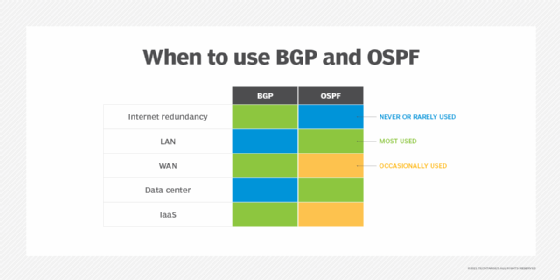
Explore the differences between Border Gateway Protocol (BGP) and Open Shortest Path First (OSPF) and when to use each protocol.