ADSL (Asymmetric Digital Subscriber Line)

What is ADSL (Asymmetric Digital Subscriber Line)?
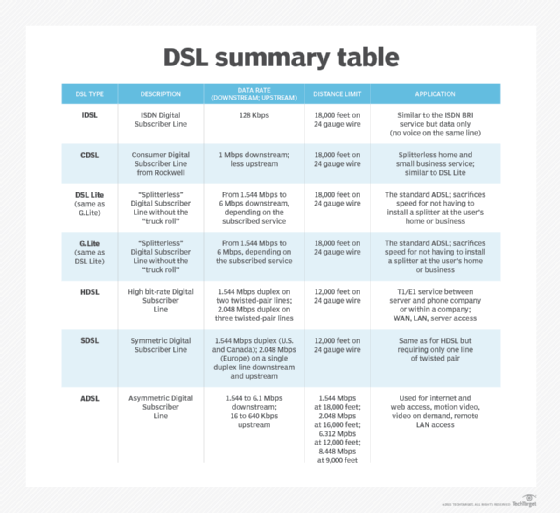
ADSL (Asymmetric Digital Subscriber Line) is a technology that facilitates fast data transmission at a high bandwidth on existing copper wire telephone lines to homes and businesses.
Unlike regular dial-up copper telephone line service, ADSL provides continuously available, always-on broadband connections. ADSL is asymmetric in that it uses most channels to transmit downstream to the user and only a small part for uploading information from the user.
By 2000, ADSL connections and other forms of high-speed DSL were available in urban areas. ADSL simultaneously accommodates analog (voice) information and data on the same phone line. It is generally offered at downstream internet connection data rates from 512 kilobits per second (Kbps) to about 6 megabits per second (Mbps).
With ADSL -- and other forms of DSL -- telephone service providers compete with internet service providers and varied internet connection methods, such as Modems, Wi-Fi routers and fiber optic cable providers.
How does ADSL work?
ADSL works on existing copper phone lines by using a DSL filter, or splitter, to isolate the bands with higher frequencies so that the landline and the ADSL modem can be used at the same time.
At the central office, or telephone exchange, the line ends at the DSL access multiplexer (DSLAM), where an additional splitter segregates the voice signal to the phone network.
ADSL was designed to exploit the one-way nature of most multimedia communication in which large amounts of information flow toward the user and only a small amount of interactive control information is returned.
It is a cost-effective method for internet access at faster speeds compared to a traditional dial-up connection.
How does ADSL differ from SDSL?
Symmetric DSL (SDSL) is also a broadband technology that transmits data over a telephone network. However, with SDSL, the downstream bandwidth -- from the network to the subscriber -- is the same as the upstream bandwidth.
In ADSL technology, the download and upload speeds do not match. The intended purpose of ADSL service is to download content with the DSL modem and not serve content to others.