10 Gigabit Ethernet (10 GbE)
What is 10 Gigabit Ethernet (10 GbE)?
10 Gigabit Ethernet (10 GbE) is a telecommunication technology that offers data speeds up to 10 billion bits per second. Launched in 2002, GbE is also known as 10GE or 10 GigE, and although it offers a 10 times speed increase over gigabit Ethernet (1 GbE), its adoption has been gradual.
For years, 10 GbE was mostly limited to core and large data networks for large-scale providers -- mainly due to its then-high costs that smaller players could not afford. But it is now seeing increasing adoption in many other areas, including small local area networks (LANs).
10 GbE is often described as a disruptive technology. The Institute of Electrical and Electronics Engineers (IEEE) first named 10 Gigabit Ethernet 802.3ae as a standard to supplement 802.3, which defines traditional Ethernet.
The 10 GbE version of the traditional Ethernet operates in full-duplex mode, enabling the transmission of data in both directions simultaneously on the same signal carrier. This means it does not need Carrier Sense Multiple Access/Collision Detection, the protocols used by early Ethernet networks for transmission access in LANs.
Traditional Ethernet and 10 Gigabit Ethernet
10 GbE is both similar to -- and different -- from traditional Ethernet.
For example, 10 GbE, like traditional Ethernet, is a Layer 1 (physical layer) and Layer 2 (data link layer) protocol that adheres to the key attributes of existing Ethernet protocols, including the following:
- Media Access Control protocol
- Ethernet frame format
- minimum and maximum frame size
However, compared to traditional Ethernet, 10 GbE offers a more efficient and less expensive approach to moving data on backbone connections between networks. Half-duplex operations do not exist in 10 GbE since it only defines full-duplex, point-to-point links only. It also eliminates the need for repeater hubs to connect multiple Ethernet devices and for port partition and collision detection.
10 GbE works with fiber optic cable (802.ae), but it is also compatible with twisted pair copper cables (802.3ak). In addition, the data frame format in 10 GbE remains the same as with other Ethernet versions. This means 10 Gbe technology is fully interoperable with existing Ethernet protocols, and users can easily deploy it within existing networks.
10 GbE and fiber optics
Both single-mode fiber and multimode fiber systems can be used with 10 GbE. Although it is more costly, the advantage of single-mode fiber is it can work over longer distances.
Light passing through multimode fiber tends to experience differential mode delay, which is why these fibers are only used for short-distance communications under 300 meters (m). Furthermore, in such networks, low-cost lasers and terminations can be used. This is why multimode fiber is ideal for applications where cost is a critical limiting factor.
10 GbE offers data transfer rates of 10 Gb per second for distances of up to 40 kilometers over single-mode fiber and up to 300 m on multimode fiber.
What is 10 Gigabit Ethernet used for?
In an increasingly digitized, technology-powered world, the demand for high-speed data transfers is increasing. In enterprise settings, more and more computers are used for data-intensive applications. As the number of computers increases and more organizations move to the cloud, they have a need for speed that traditional 1 GbE cannot keep up with.
Enter 10 GbE, which supports connections to both LANs and wide area networks and can connect to Synchronous Optical Networks and Synchronous Digital Hierarchy WANs. It is increasingly used for data network backbones since it eliminates data bottlenecks in LANs that are common with Gigabit Ethernet.
10 GbE also provides a cost-effective means for the high-speed, low-latency requirements of newer computing applications, such as video, virtualization, streaming, data centers, regular data backups and high-end gaming.
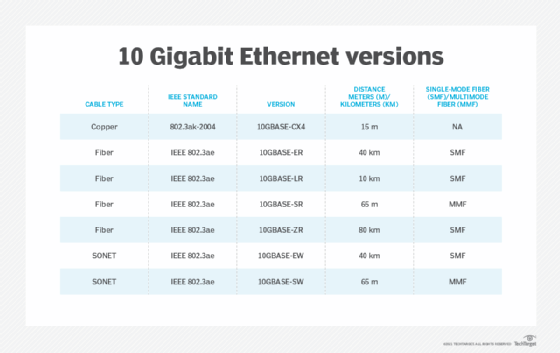
10 Gigabit Ethernet versions
Depending on the medium over which data is sent, different versions of 10 GbE are now available.
Do you need 10 Gigabit Ethernet?
Those currently using 1 GbE may be thinking about moving to 10 GbE. There are a few things you should keep in mind, however.
First, what kind of applications do you need 10 GbE for? If 1 GbE is enough to meet these needs, a transition to 10 GbE is not required.
Next is the cost: 1 GbE is considerably cheaper than 10 GbE, even with all components included. For many applications, 1 GbE technologies also provide a balance between network efficiency, cost effectiveness and performance.
On the other hand, the prices of 10 GbE components are constantly falling, and more businesses can now afford them. 10 GbE also delivers faster speeds with less compression and latency. So, for those that have video applications or frequently back up large data volumes, 10 GbE may be the best choice.