coded orthogonal frequency-division multiplexing (COFDM)

What is coded orthogonal frequency-division multiplexing (COFDM)?
Coded orthogonal frequency-division multiplexing (COFDM) is a telecommunications modulation scheme that divides a single digital signal across 1,000 or more signal carriers simultaneously. The signals are sent at right angles to each other -- hence, orthogonal -- so that they don't interfere with each other.
COFDM is used predominantly in Europe. In the U.S., the Advanced Television Systems Committee has chosen 8-level vestigial sideband as its equivalent modulation standard.
COFDM for terrestrial broadcasting
Coded orthogonal frequency-division multiplexing splits a broadband channel into multiple narrow, discrete subchannels or subcarriers. It is ideal for terrestrial broadcasting channels, such as radio and television, in part because it can deal with high levels of multipath propagation.
An inherent characteristic of radio broadcasting, multipath propagation occurs when a wireless signal encounters obstructions, such as trees and buildings, causing it to split into multiple paths. Ordinarily, this can cause issues such as interference or degradation, although COFDM is adept at mitigating these challenges.
COFDM can support single-frequency networks, enabling multiple transmitters to send the same signal on the same frequency. It can also effectively handle co-channel narrowband interference, which occurs when two transmitters use the same channel, caused by analog carriers.
COFDM is particularly well suited for two terrestrial broadcasting standards:
- Digital Audio Broadcasting. Also known as DAB, this standard is known for its resilience in handling signal reception problems in moving cars.
- Digital Video Broadcasting-Terrestrial. This standard, also known as DVB-T, requires high capacity and multipath tolerance to support the use of set-top TV antennas.
It can meet the requirements of both standards by modulating data onto multiple carriers using frequency-division multiplexing (FDM), which combines multiple signals into a single channel. COFDM can accomplish this thanks to three key features that reduce interference:
- orthogonality;
- addition of a guard interval, which introduces a short delay between transmissions; and
- use of error correction coding, interleaving (a process for correcting burst errors) and channel-state information (data about the various properties of a communications link).
What is the difference between OFDM and COFDM?
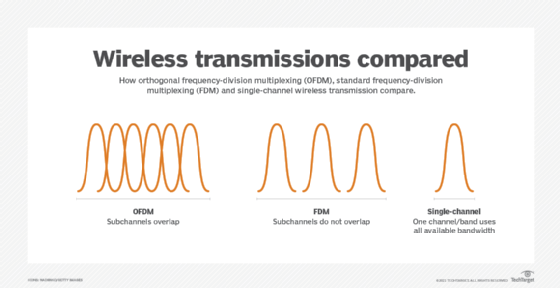
Orthogonal frequency-division multiplexing (OFDM) is a technique for dividing a single channel into multiple carriers, each modulated by a low-rate data stream and then allocated to users. In this sense, OFDM is similar to another transmission method: frequency-division multiple access (FDMA).
But, unlike FDMA, OFDM reduces the space between channels by making them orthogonal to one another. This prevents interference between carriers without the need to filter each carrier in the frequency. OFDM also uses the spectrum more efficiently than FDMA.
COFDM is the same as OFDM with one key difference: Before signal transmission, forward error correction (FEC) is applied to it. The goal is to overcome any errors in the transmission due to carrier losses caused by channel noise, frequency-selective fading or other propagation concerns.
How COFDM works
Traditionally, channels are isolated from each other to avoid the problem of frequency-selective fading. In COFDM, this issue is resolved by using FEC coding. This refers to the C, or coded, in COFDM.
Uncoded OFDM does not perform well in selective channels, especially if there is a carrier that's badly affected by interference. Simply adding hard-decision decoding to this system is insufficient. What is required is an OFDM system with convolutional coding and soft-decision decoding.
Convolutional coding is a popular FEC technique, widely used in digital wireless communications. It is not based on blocks of bits. Instead, the output code bits are determined by logical operations on the present bit and a small number of previous bits in a data stream.
FEC transforms a certain number of bits into a larger number of bits containing information redundancy. As a result, even if a subcarrier suffers frequency-selective fading, the original data can still be recovered.
How COFDM addresses intersymbol interference in multipath propagation
In multipath propagation, a single signal is received via multiple paths, with a relative delay between them. The late arrival of the scattered portions of the signal causes ghost images. For an integration period (symbol n), if the relative delay is more than one symbol period, the signal from the second path only carries information belonging to the previous symbol or symbols. Thus, it is intersymbol interference (ISI).
To cope with delayed signals, the symbol rate must be reduced so that the delay spread between the first- and last-received paths is a small fraction of the symbol period. FDM, the first step toward COFDM, divides the high-rate data into multiple low-rate, parallel data streams -- each conveyed by its own carrier. In wireless COFDM, the symbols become longer, depending on the number of subcarriers used.
Even when the relative delay is less than one symbol period, some ISI from the previous symbol still remains. Adding a silent guard interval between each transmitted symbol addresses this problem. It ensures that the receiver has time to receive a copy of the symbol arriving on a longer reflected path without overlapping with the next symbol. The guard interval required to account for differences in path length can be longer than the symbol, in which case the silent period will dominate and decrease the data amount that can be sent.
How is COFDM used today?
The main reason Europe uses COFDM is due to its ability to overcome multipath effects. Stations transmit the same signal across many borders using single-frequency networks and multiple transmitters.
Since COFDM uses multiple carriers to transmit the same signal, it is ideal for such networks, enabling European TV viewers to watch the same broadcast without interference. COFDM is also suitable for free digital television programming and mobile television viewing.