modulation
What is modulation?
Modulation is the process of converting data into radio waves by adding information to an electronic or optical carrier signal. A carrier signal is one with a steady waveform -- constant height, or amplitude, and frequency.
How modulation works
Information can be added to the carrier by varying its amplitude, frequency, phase, polarization -- for optical signals -- and even quantum-level phenomena like spin.
Modulation is usually applied to electromagnetic signals: radio waves, lasers/optics and computer networks. Modulation can even be applied to a direct current -- which can be treated as a degenerate carrier wave with a fixed amplitude and frequency of 0 Hz -- mainly by turning it on and off, as in Morse code telegraphy or a digital current loop interface. The special case of no carrier -- a response message indicating an attached device is no longer connected to a remote system -- is called baseband modulation.
Modulation can also be applied to a low-frequency alternating current -- 50-60 Hz -- as with powerline networking.
What are the types of modulation?
There are many common modulation methods, including the following, which is an incomplete list:
- Amplitude modulation (AM): The height (i.e., the strength or intensity) of the signal carrier is varied to represent the data being added to the signal.
- Frequency modulation (FM): The frequency of the carrier waveform is varied to reflect the frequency of the data.
- Phase modulation (PM): The phase of the carrier waveform is varied to reflect changes in the frequency of the data. In PM, the frequency is unchanged while the phase is changed relative to the base carrier frequency. It is similar to FM.
- Polarization modulation: The angle of rotation of an optical carrier signal is varied to reflect transmitted data.
- Pulse-code modulation: An analog signal is sampled to derive a data stream that is used to modulate a digital carrier signal.
- Quadrature amplitude modulation (QAM): Uses two AM carriers to encode two or more bits in a single transmission.
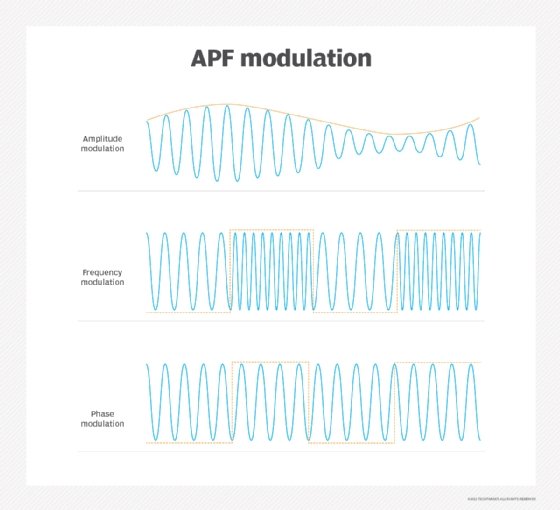
Radio and television broadcasts and satellite radio typically use AM or FM. Most short-range two-way radios -- up to tens of miles -- use FM, while longer-range two-way radios -- up to hundreds or thousands of miles -- typically employ a mode known as single sideband (SSB).
More complex forms of modulation include phase-shift keying (PSK) and QAM. Modern Wi-Fi modulation uses a combination of PSK and QAM64 or QAM256 to encode multiple bits of information into each transmitted symbol.
PSK conveys data by modulating the phase of the carrier signal by varying the sine and cosine inputs at precise times. PSK is used widely for wireless LANs, RFID and Bluetooth communications. The demodulator determines the phase of the signal received and translates it back to the symbol it represents.
Why use modulation
The carrier wave used by radio frequency (RF) transmissions doesn't carry much information itself. To include speech or data, another wave has to be superimposed on the carrier wave, thus changing the shape of the carrier wave. The process of doing so is called modulation. To transmit sound, the audio signal must first be converted into an electric signal, using a transducer. After conversion, it is used to modulate a carrier signal.
Analog vs. digital
Modulation schemes can be analog or digital. An analog scheme has an input wave that varies continuously like a sine wave. In digital modulation scheme, voice is sampled at some rate and then compressed and turned into a bit stream, and this in turn is created into a particular kind of wave which is then superimposed on the carrier signal.
Modulation and demodulation
Modulation is the process of encoding information in a transmitted signal, while demodulation is the process of extracting information from the transmitted signal. Many factors influence how faithfully the extracted information replicates the original input information. Electromagnetic interference can degrade signals and make the original signal impossible to extract. Demodulators typically include multiple stages of amplification and filtering in order to eliminate interference.
A device that performs both modulation and demodulation is called a modem -- a name created by combining the first letters of MOdulator and DEModulator.
A computer audio modem allows a computer to connect to another computer or to a data network over a regular analog phone line by using the data signal to modulate an analog audio tone. A modem at the far end demodulates the audio signal to recover the data stream. A cable modem uses network data to modulate the cable service carrier signal.
Sometimes a carrier signal can carry more than one modulating information stream. Multiplexing combines the streams onto a single carrier -- e.g., by encoding a fixed-duration segment of one, then of the next, for example, cycling through all the channels before returning to the first -- a process called time-division multiplexing (TDM). Another form is frequency-division multiplexing (FDM), where multiple carriers of different frequencies are used on the same medium.
In another form, wavelength-division multiplexing (WDM) modulates multiple laser wavelengths/frequencies on long-haul fiber links to increase the total available bandwidth.
Why use modulation in communications?
Multiple carriers of different frequencies can often be transmitted over a single media, with each carrier being modulated by an independent signal. For example, Wi-Fi uses individual channels to simultaneously transmit data to and from multiple clients.
A carrier signal is used to reduce the wavelength for efficient transmission and reception. Because the optimum antenna size is one-half or one-quarter of a wavelength, an audio frequency of 3000 Hz would need a wavelength of 100 km and a 25-kilometer antenna. Instead, using an FM carrier of 100 MHz, with a wavelength of 3 meters, the antenna would only need to be 80 cm long.
Modulation and duty cycle
In wireless communications, the duty cycle is the proportion of time that the wireless network transmits RF signals. The duty cycle is thus an important factor in assessing the electromagnetic radiation to which a person is exposed. The actual duty cycle can vary, depending on the data load on the network and the network speed. So, the duty cycle can be affected by whether the network is being used for VoIP, streaming videos or videos, etc.