application layer
What is the application layer?
The application layer sits at Layer 7, the top of the Open Systems Interconnection (OSI) communications model. It ensures an application can effectively communicate with other applications on different computer systems and networks.
The application layer is not an application. Instead, it is a component within an application that controls the communication method to other devices. It is an abstraction layer service that masks the rest of the application from the transmission process.
The application layer relies on all the layers below it to complete its process. At this stage, the data or the application is presented in a visual form that the user can understand.
Functions of the application layer
The application layer handles the following functions:
- ensures that the receiving device is identified, reachable and ready to accept data;
- when appropriate, enables authentication between devices for an extra layer of network security;
- makes sure necessary communication interfaces exist, such as whether there is an Ethernet or Wi-Fi interface in the sender's computer;
- ensures agreement at both ends on error recovery procedures, data integrity and privacy;
- determines protocol and data syntax rules at the application level; and
- presents the data on the receiving end to the user application.
Two types of software provide access to the network within the application layer:
- network-aware applications, such as email; and
- application-level services, such as file transfer or print spooling.
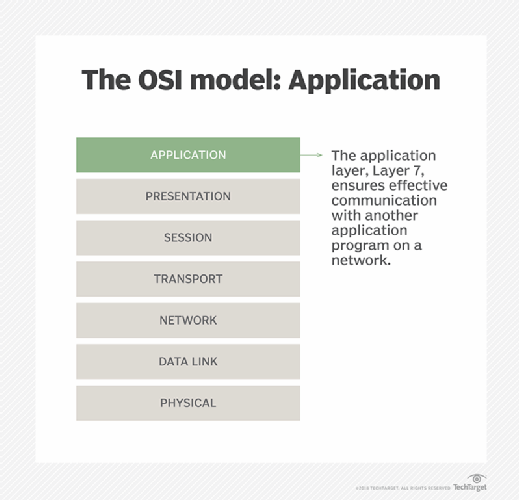
How the OSI model works in practice
Prior to the creation of the OSI model, applications ran on separate systems. They used different network technologies that could not communicate or exchange information.
To solve that issue, the International Organization for Standardization designed a layered approach to accommodate changes in technology. It breaks down technology inconsistencies to foster greater information interchange.
Devices, such as routers and switches, have OSI protocols embedded in their firmware to facilitate computer networking among different systems and network infrastructures. Applications contain protocols to facilitate the data transfer process with lower OSI layers.
Each of the layers of the OSI model handles different network functions. They do this by transferring specific information between upper and lower layers during data processing and information exchange.
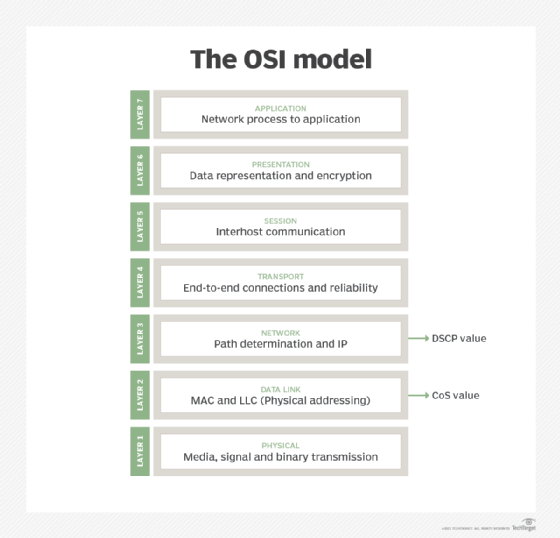
OSI layers and their functions in a communications network
The seven OSI layers are the following:
- Physical layer. In the physical layer, devices such as a local area network or router physically link to a network.
- Data link layer. The data link layer defines how data is transferred over a connecting link.
- Network layer. The network layer determines how messages move across a network, such as end-to-end movement of data packets using logical addresses.
- Transport layer. The transport layer facilitates error recovery and reorders data packets that are in the wrong sequence.
- Session layer. The session layer manages all phases of a session, including setup, in-process control functions and message takedown, and supports concurrent transmission of multiple bidirectional messages.
- Presentation layer. The presentation layer supports message formatting and encryption.
- Application layer. This layer facilitates the communication with applications running on other computers.
Examples of application layer protocols
The application layer was developed with two sublayers:
- Common application service element (CASE) provides services for the application layer and requests services from the session layer. Its activities include remote operation control and data transfer. CASE services are applicable to a variety of application requirements.
- Specific application service element (SASE) provides application-specific services, such as file transfer, remote database access, application management information and transaction processing.
Early application layer protocols the Internet Engineering Task Force specified in Request for Comments 1233 included the following four -- each of them is still in use today:
- File Transfer Protocol, or FTP, handles file transfer activities.
- Simple Mail Transfer Protocol, or SMTP, handles movement of electronic mail.
- Domain Name System, or DNS, maps the name used for a website to its IP address.
- Simple Network Management Protocol, or SNMP, provides remote host management.
Here are some examples of well-known application layer protocols in use today:
- Bitcoin for digital currency;
- Hypertext Transfer Protocol for message communications;
- H.323 for packet-based communications, such as voice over IP;
- Lightweight Directory Access Protocol for queries of user information;
- Network File System for data storage and retrieval from various media;
- Remote Procedure Call to execute a procedure or subroutine on a different system or network; and
- X.400 Message Handling Service Protocol that facilitates the transfer of email among compatible systems.
Numerous communications protocols and interface methods have been developed based on the OSI model. Today, communication with remote hosts are common and use a variety of web browsers, the application layer and its six complementary layers.
Find out about the 12 networking protocols you should know and understand.