Seebeck effect

What is the Seebeck effect?
The Seebeck effect is a phenomenon in which a temperature difference between two dissimilar electrical conductors or semiconductors produces a voltage difference between the two substances.
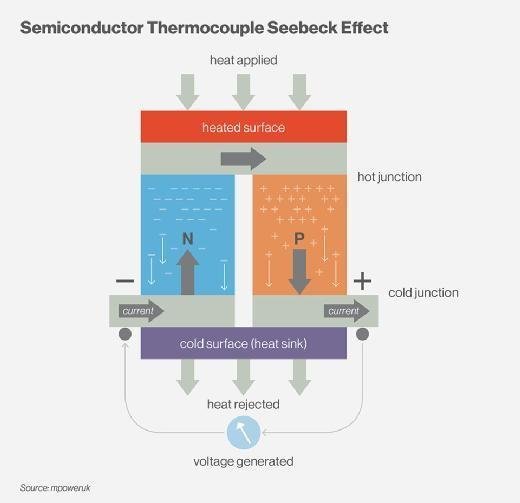
When heat is applied to one of the two conductors or semiconductors, heated electrons flow toward the cooler conductor or semiconductor. If the pair is connected through an electrical circuit, direct current (DC) flows through that circuit.
Seebeck effect: Key findings
The Seebeck effect refers to the buildup of electric potential which happens when there is a temperature gradient between different electrical conductors or semiconductors.
Here are some key findings of this phenomenon:
- The voltages produced by the Seebeck effect are small, usually only a few microvolts (millionths of a volt) per kelvin of temperature difference at the junction between the conductors or semiconductors.
- If the temperature difference is large enough, some Seebeck-effect devices can produce a few millivolts (thousandths of a volt).
- Numerous such devices can be connected in series to increase the output voltage or in parallel to increase the maximum deliverable current.
- Large arrays of Seebeck-effect devices can provide useful, small-scale electrical power if a large temperature difference is maintained across the junctions.
Seebeck effect: Explanation
In 1821, German physicist Thomas Seebeck discovered that when two wires made from dissimilar metals are joined at two ends to form a loop, and if the two junctions are maintained at different temperatures, a voltage develops in the circuit. This phenomenon is therefore named after him.
When heat is applied to one of the two conductors or semiconductors, that metal heats up. Consequently, the valence electrons present in this metal flow toward the cooler metal. This happens because electrons move to where energy (in this case, heat) is lower. If the metals are connected through an electrical circuit, direct current flows through the circuit.
However, this voltage is just a few microvolts per kelvin temperature difference. Thermal energy is continuously transferred from the warmer metal to the cooler metal until eventually, temperature equilibrium is obtained.
The Seebeck effect and its resultant thermoelectric effect is a reversible process. If the hot and cold junctions are interchanged, valence electrons will flow in the other direction, and also change the direction of the DC current.
Seebeck effect and thermocouples
The pair of metal wires forming the electrical circuit is known as a thermocouple. On a larger scale and due to the Seebeck effect, thermocouples are used to approximately measure temperature differences. They are also used to actuate electronic switches that can turn large systems on and off, a capability that is employed in thermoelectric cooling technology.
Seebeck used copper and bismuth in his experiment. Other common thermocouple metal combinations that are used today include the following:
- constantan and copper
- constantan and iron
- constantan and chromel
- constantan and alumel
Applications of Seebeck effect
There are many applications of the Seebeck effect. In addition to its use in thermocouples to measure temperature differences, the phenomenon is also used in the following ways:
- in thermopiles (that is, in a setting where a number of thermocouples are connected in series);
- in thermoelectric generators that function as heat engines;
- in power plants to convert waste heat into (extra) power;
- in automobiles as automotive thermoelectric generators, to increase fuel efficiency;
- in high-frequency electrical power sensors;
- to verify material degradation and radiation level, and to perform strength testing of radioactive materials (which vary with temperature over a given time period); and
- to actuate security alarms or switches.
Spin Seebeck effect
In 2008, physicists discovered the Spin Seebeck effect (SSE). This effect refers to the generation of a spin voltage caused by a temperature gradient in a ferromagnet. This gradient enables the thermal injection of spin currents from the ferromagnet into a nonmagnetic metal. This injection happens over a macroscopic scale of several millimeters.
SSE is seen when heat is applied to a magnetized metal. As a result, electrons rearrange themselves according to their spin. Unlike ordinary electron movement, this rearrangement does not create heat as a waste product.
The effect could lead to the development of smaller, faster and more energy-efficient microchips or switches, as well as spintronics devices.
Seebeck effect vs. Peltier effect
In 1834, Jean Peltier, a French watchmaker, discovered another second thermoelectric effect that was later named the Peltier effect. Peltier observed that when a current flows through a circuit containing a junction of two dissimilar metals -- similar to the setup in the Seebeck effect -- heat is either absorbed or liberated at the junction. This absorption or liberation depends on the pair of metals used and the direction of the current.
The Seebeck effect and Peltier effect both involve circuits made from dissimilar metals, as well as heat and electricity. Both are also reversible processes. But despite these similarities, there are some differences between these effects as well.
The Seebeck effect occurs when the two ends of a thermocouple are at different temperatures, which results in electricity flowing from the hot metal to the cold metal.
In the Peltier effect, a temperature difference is created between the junctions when electrical current flows across the terminals. In a copper-constantan thermocouple in which the current at the junction is flowing from copper (+) to constantan (-), heat will be absorbed. But if the direction of the current is reversed -- i.e., from constantan (-) to copper (+) -- it will result in heat liberation.